

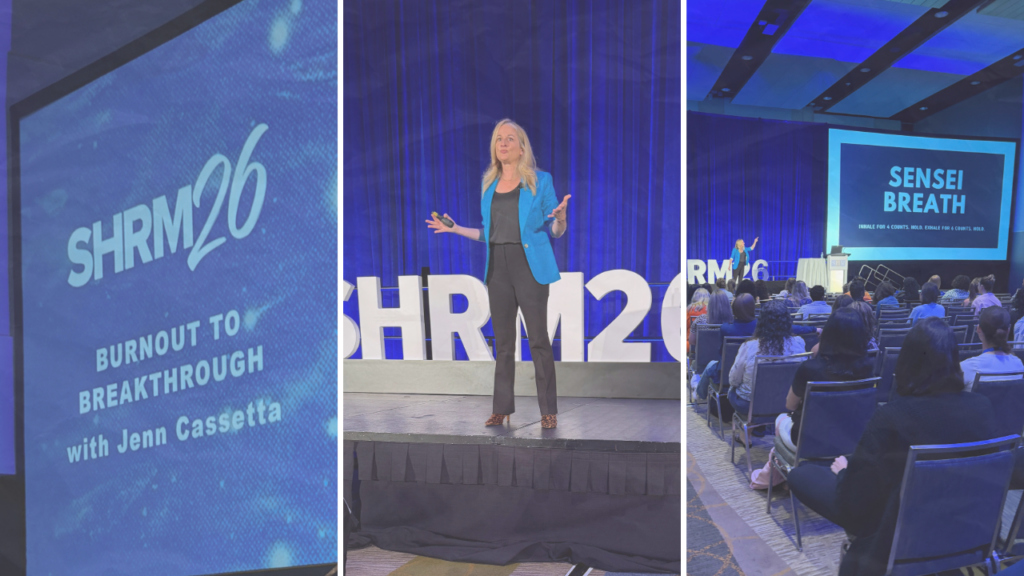
How Can HR Leaders Build Resilience and Perform at Their Best Without Burning Out? Jenn Cassetta, high-performance coach and speaker, brought a martial arts-inspired answer to SHRM26 in Orlando.
HR professionals are often the caretakers of the workforce. They support employees through difficult conversations, manage competing priorities, shape workplace culture, navigate leadership expectations, and help organizations move forward during times of uncertainty.
However, one important question often gets overlooked:
Who is taking care of the people taking care of everyone else?
That question was at the heart of Jenn Cassetta’s SHRM26 session, “Burnout to Breakthrough: Building Boundaries, Energy, and Resilience That Last.” As a high-performance coach and speaker, two-time TEDx speaker, author, and third-degree black belt in Hapkido, Jenn Cassetta combines martial arts wisdom with practical performance strategies to help leaders build resilience, manage stress, protect their energy, and perform at a high level without sacrificing their wellbeing.
At SHRM26 in Orlando, she invited HR professionals to look at burnout prevention, resilience, boundaries, and sustainable high performance through a different lens: the martial arts.
What Can Martial Arts Teach Us About Burnout and Resilience?
In martial arts, strength isn’t simply about using more force. Instead, it’s about awareness. It’s also about knowing when to move, when to pause, how to conserve energy, and how to respond effectively under pressure. With more than two decades of martial arts training and a third-degree black belt in Hapkido, Jenn Cassetta has spent years studying and teaching these principles.
Inside the dojo, martial artists learn to:
- Stay calm under pressure
- Develop greater self-awareness
- Conserve energy
- Respond instead of react
- Establish physical and mental boundaries
- Build confidence through practice
- Remain present during challenging situations
These same skills can be applied to modern leadership. For HR professionals and business leaders, resilience isn’t simply about pushing through another difficult day. Instead, it’s about developing the capacity to navigate pressure without constantly operating from exhaustion.
Ultimately, that distinction is at the heart of sustainable high performance.
The Resilience Ladder: A Framework for Sustainable High Performance
During her SHRM26 session, Jenn introduced her signature Resilience Ladder, a martial arts-inspired framework designed to help leaders strengthen their ability to navigate stress and pressure.
The framework focuses on several interconnected skills:
- Awareness – Recognize your thoughts, emotions, energy levels, and physical signals.
- Boundaries – Identify what deserves your attention and what doesn’t.
- Self-talk – Shift the internal dialogue that can amplify stress.
- Energy management – Learn to manage your energy rather than simply managing your time.
- Purpose – Connect daily decisions and leadership behaviors to what matters most.
Rather than treating resilience as an abstract concept, the approach gives leaders practical tools they can use in real situations. More importantly, SHRM26 wasn’t simply a sit-and-listen experience. Hundreds of HR professionals got on their feet to practice physical boundary-setting techniques, use affirmations, and learn how to redirect their energy rather than absorb everyone else’s stress.
As a result, the conference room became a dojo.
Burnout Prevention Starts With Awareness
One of the first skills developed in martial arts is awareness. This includes awareness of your surroundings, your body, your thoughts, and your emotions. It also means recognizing the signals that tell you something is wrong before you reach complete exhaustion.
Similarly, workplace burnout doesn’t always arrive as one dramatic event. Instead, it can build gradually through constant interruptions, excessive workloads, unclear boundaries, emotional demands, and the expectation that everything is urgent. By learning to recognize those signals earlier, leaders have an opportunity to respond before stress becomes overwhelming.
For that reason, self-awareness is a critical leadership skill.
Your Breath Is a Powerful Performance Tool
Another practical lesson from Jenn’s SHRM26 session was surprisingly simple:
Breathe.
Intentional, slow breathing can help create space between a stressful event and your response. In turn, that brief pause can make it easier to respond thoughtfully rather than react automatically.
During the session, Jenn guided attendees through her Sensei Breath, a simple breathing practice that can be used before:
- A difficult conversation
- A high-stakes presentation
- A challenging leadership decision
- A stressful meeting
- A conflict with a colleague
- Any situation where pressure starts taking over
The goal isn’t to eliminate stress. Instead, the goal is to develop the ability to respond to stress more skillfully. That distinction matters. High performance doesn’t mean never feeling stressed. Rather, it means developing the skills, awareness, and practices that help you stay grounded when stress shows up. Just as martial artists train consistently so their skills are available under pressure, leaders can develop small daily habits that strengthen their ability to manage demanding situations.
Try it: Before your next difficult conversation, pause. Take a slow breath. Notice what is happening in your body. Then choose your response rather than immediately reacting.
From Personal Resilience to Organizational Wellbeing
For HR professionals, burnout prevention cannot stop at individual self-care. In addition, leadership behavior has a significant influence on organizational culture.
Consider what happens when leaders consistently:
- Answer emails at midnight
- Skip breaks
- Work through every lunch
- Treat every request as an emergency
- Remain constantly available
- Reward overwork
- Normalize exhaustion
Over time, those behaviors can become the unspoken expectations of the workplace. Consequently, workplace wellbeing and employee wellbeing require more than individual resilience. Personal resilience is valuable; however, it cannot compensate for unsustainable workloads or unhealthy workplace practices.
Building a resilient organization requires both:
Individual skills + leadership commitment
Leaders can teach employees how to manage stress, but organizations also need to examine the systems, expectations, workloads, and cultural norms that contribute to chronic stress.
For HR leaders, this means looking at resilience from both sides:
How can we help people become more resilient?
And:
How can we create an environment where people don’t have to constantly use resilience just to survive the workday?
Ultimately, that is where sustainable high performance begins.
💬What SHRM26 Attendees Had to Say💬
One of my favorite parts of speaking at conferences isn’t just what happens during the session. It’s what happens afterward.
I love hearing from people about the moment that stuck with them, the idea they took back to their teams, or the small shift they decided to make in their own lives. That’s when I know the message has moved beyond the stage and into the real world.
Following SHRM26, I was especially excited to see HR professionals sharing their takeaways and reflections on LinkedIn. Their responses reminded me why I love working with HR leaders and high-performing professionals who spend so much of their time supporting everyone else.
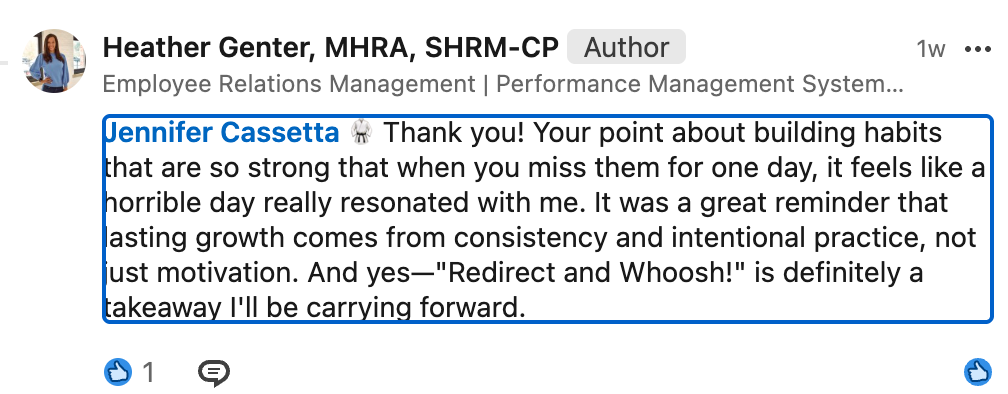
One attendee reflected on the unexpected connection between HR and martial arts, sharing how the session reinforced the importance of discipline, self-mastery, and learning to redirect energy rather than absorb it.
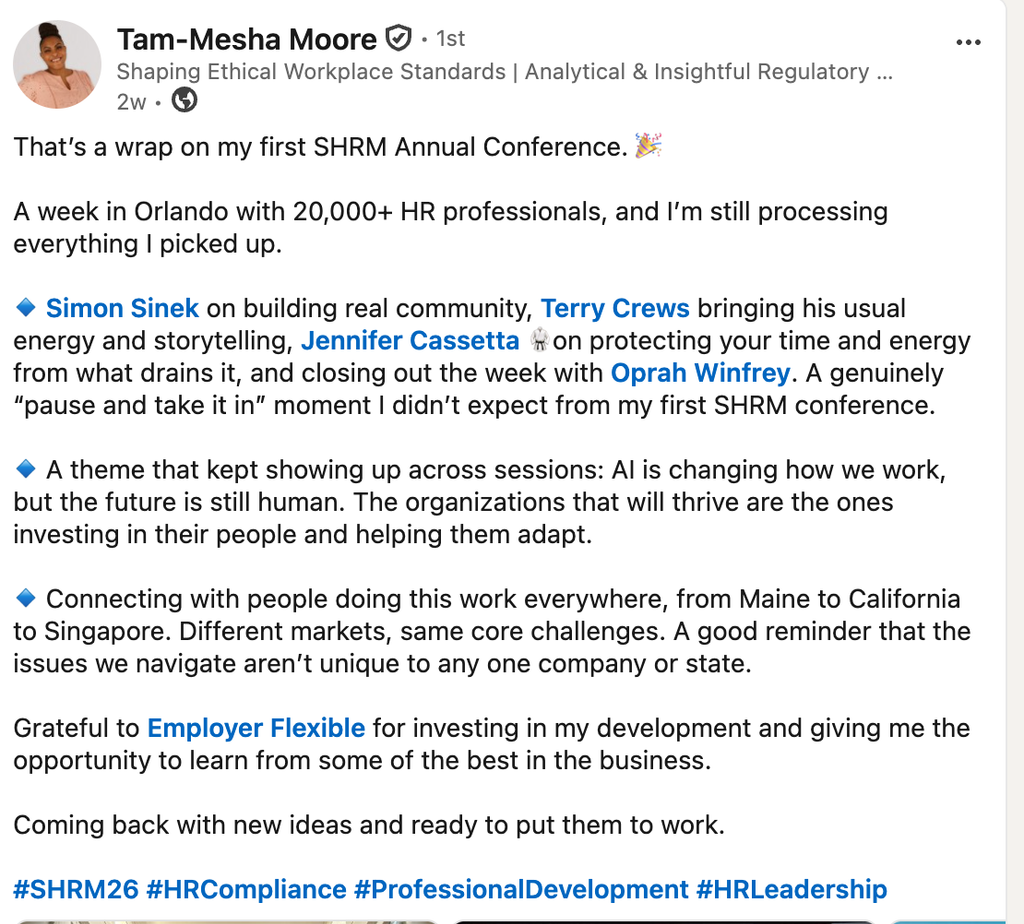
These comments meant a lot to me because they capture exactly what I hope people take away from my sessions: practical tools they can actually use, a new way of looking at stress and resilience, and hopefully a little more permission to protect their own energy.
“As someone who walked in feeling burnt out, Jennifer both identified and simplified a roadmap to rejuvenation and not let the journey take everything from you. Very helpful. Thank you!”
“This was awesome and helpful information! I also have a martial arts background and I’ve never heard stress management explained in terms of martial arts lingo- very creative and memorable.”
“Amazing. Useful, actionable content. I texted my team halfway through the content and told them they were badasses 😉 and to remember to breathe using the 4s, hold, 6s, hold.”
“This session was absolutely amazing and so inspiring! My favorite break out of the week!”
“As a virtual participant – I loved the part where she got us up out of our seats for a little physical boundary setting and the power poses and the self affirming mantras. She was fun and energetic even on screen.”
That’s what I love most about this work. When someone takes a tool from the room and immediately shares it with their team, the learning has already begun to extend beyond the conference.
And that’s how small practices can create a ripple effect.
About Jennifer Cassetta

Jennifer Cassetta is a high-performance coach, keynote speaker, martial arts expert, author, and podcast host who helps individuals and organizations build confidence, resilience, leadership skills, and sustainable performance.
Through her talks, writing, and online content, she shares practical tools that are designed to meet audiences where they are—whether they are navigating workplace challenges, personal growth, leadership development, conflict, or major life transitions.
Explore more of Jennifer’s insights through her website, blog, podcast, and video content.
Share & Follow
For inquiries:
Jennifer Cassetta
Website: jennifercassetta.com
YouTube: https://www.youtube.com/@jenncassetta