What do women leaders need to thrive—not just perform? After speaking at the Prestige Global Meetings & Event Solutions + Preferred Hotels Women in Leadership event at Alisal Ranch, Jennifer Cassetta reflects on the power of connection, boundaries, and resilience. From her interactive Black Belt Leadership keynote to conversations around the campfire and beyond the conference room, this gathering offered a powerful reminder: sustainable leadership starts with protecting your energy, creating meaningful connections, and making space for yourself.
What does it take to thrive under pressure, lead with confidence, and sustain high performance without burning out? In The Black Belt Mindset: Building Resilience and High Performance in Business, keynote speaker and third-degree black belt Jennifer Cassetta shares powerful lessons from the martial arts dojo that translate directly into the business world. Drawing on insights from her keynote at BizX Houston, she explores how resilience, energy management, confidence, and disciplined leadership help entrepreneurs and business coaches navigate challenges, overcome setbacks, and perform at their best. Discover why success requires more than strategy, and how adopting a black belt mindset can help you build sustainable success in business and life.
What if grief isn’t just about death, but an energy that can transform your life?
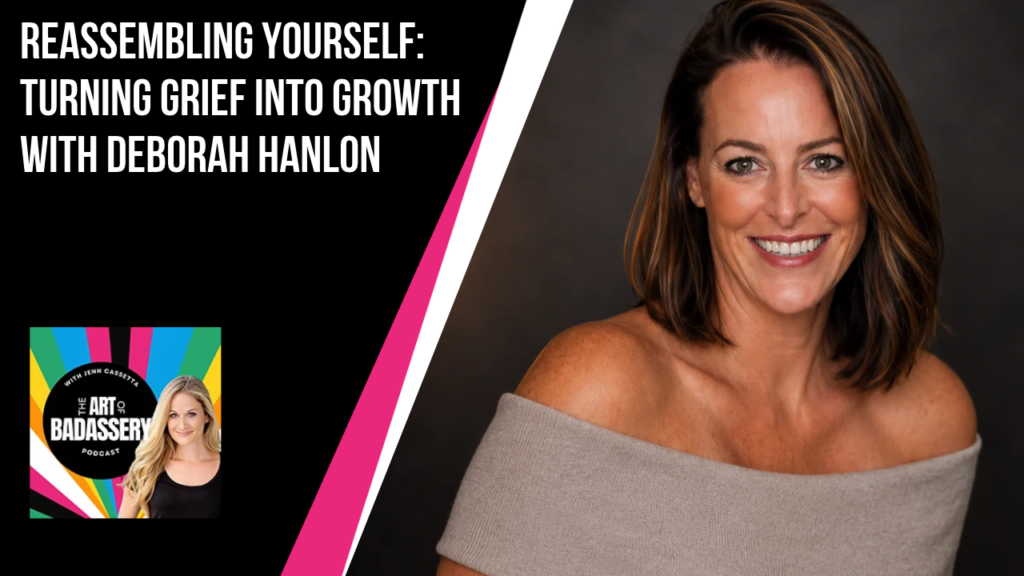
This week, Jenn Cassetta welcomes back intuitive medium, author, and consciousness coach Deborah Hanlon to discuss her book Reassembling Yourself: Turning Grief into Growth and expanding grief to include “micro griefs” like breakups, career changes, unmet dreams, and empty nesting. Deborah shares how Neale Donald Walsch unexpectedly wrote the book’s foreword after they connected through coaching, including a full-circle link to an event with Dr. Elisabeth Kübler-Ross. She explains how unprocessed grief is stored in the body and can become identity, introduces “inherited grief,” and outlines her non-linear stages—drop, daze, cocoon, goo phase, breakthrough, and echo—emphasizing presence over trying to “fix” grief. They close with rapid-fire questions, Deborah’s meditation routine, favorite books, and where to find her online.
Watch the episode here
In this podcast episode, Deborah discusses her journey and introduces her new book, “Reassembling Yourself: Turning Grief into Growth.” This book and our conversation delve deeply into grief, exploring beyond the traditional concept of losing someone and moving on. Whether you’re grieving the end of a relationship, a job, or a dream, we hope this discussion and Deborah’s insights guide you to transform grief into growth.
A Journey of Transformation with Deborah Hanlon
Deborah shares her story of how her book’s introduction by Neale Donald Walsch came to be, a dream she once thought unlikely. Her connection with Walsch, author of “Conversations with God,” has shaped her thoughts on spirituality and self-understanding. She recounts the meaningful and seemingly serendipitous experience of having him write the forward for her book.
The book is not solely about dealing with death but dives into various forms of grief we experience in life. Deborah introduces concepts like “micro griefs” and “inherited grief,” encouraging us to expand our understanding of grief beyond losing loved ones. These micro griefs—disappointments, breakups, unmet expectations—permeate our daily lives. Understanding and acknowledging these subtle facets of grief can contribute to profound personal growth.
Understanding the Stages of Grief
Deborah outlines her unique framework and stages of grief. Concepts like the “Drop,” the moment life feels permanently different, and the “Daze,” a state of numbness and disbelief, illustrate how grief can be a transformative force. She emphasizes that these stages are not linear but rather a spiral, revisiting and evolving over time.
In particular, the “Goo Phase” resonates with many; it’s a period of being in-between, not yet transformed, but no longer the same. This phase encourages us to rest and reassess without the pressure to immediately redefine ourselves.
Moving Forward through Echoes of Grief
As we process and move with grief, Deborah highlights the “Breakthrough” and “Echo” phases. Breakthroughs symbolize forward movement and newfound motivation, while the Echo represents lingering pangs of grief—moments that once leveled us but now pass quicker.
Her book, “Reassembling Yourself,” offers guidance for recognizing and navigating these stages, helping us process our unique grief journeys without self-judgment or predefined timelines.
Conclusion: Embrace Presence and Transformation
Our conversation with Deborah Hanlon reaffirms the importance of presence and self-compassion in grief. Her insights encourage us to honor our personal processes, transforming grief into a powerful vehicle for change rather than a stagnating force.
For anyone seeking to understand and harness grief’s transformative potential, I highly recommend picking up a copy of Deborah’s book. It’s a tool for reflection, presence, and growth, ideal for anyone navigating the complexities of grief in its various forms.
For over two decades, Deborah Hanlon has empowered people to harness the transformative power of grief, helping them to heal, grow, and step into their highest potential. With a unique blend of science, spirituality, and intuition, Deborah leads her clients on a journey of self-awareness, tapping into their inner strength to unlock the lives they are destined to live. Her teachings, grounded in both psychology and metaphysics, offer a refreshing realism that honors skepticism and celebrates the mystery of the human spirit.
What if a milestone birthday wasn’t just something to celebrate, but an invitation to get intentional about the life you’re creating? For her 50th birthday, Jenn Cassetta created a list of 50 things she wanted to do before turning 50. From health and adventure to business, relationships, self-care, and pure joy, discover what made her list, what she accomplished, what she didn’t—and how you can create your own milestone bucket list at any age.
What if the ancient wisdom of martial arts could help you navigate modern chaos, protect your peace and reclaim your power? In Secrets of the Sensei, Jennifer Cassetta, a high performance coach and speaker, shares nine powerful secrets for emotional self-defense, resilience, stronger boundaries and sustainable high performance.
What can a third-degree black belt teach us about leadership? At the CASBO Women in Leadership event, Jennifer Cassetta brought her *Art of Badassery* framework to California women leaders through an interactive **Black Belt Leadership** keynote focused on resilience, confidence, boundaries, energy management, and sustainable high performance.
Have you ever wondered, “Why am I so exhausted when I’m doing everything right?” What if burnout isn’t a personal failure, but a sign that something in your life or work is out of alignment?
Jenn Cassetta sits down with burnout expert, host of the Fried podcast, and author Cait Donovan (The Bouncebackability Factor and Mismatch: Why Good People Burn Out in Good Organizations) to unpack why good people burn out and what it really takes to recover.
Cait shares her own years-long journey through burnout, the symptoms she struggled to explain, and the support that finally helped her heal. Together, they explore the WHO’s definition of burnout, the hidden roots of chronic stress, and why boundaries and resilience aren’t always the simple solutions they’re made out to be.
From the impact of childhood experiences and constant digital overwhelm to the role of community, access to resources, and workplace culture, this conversation challenges everything you thought you knew about burnout.
Plus, discover how to recognize the mismatch between your values and your reality, identify what’s draining your energy, and start creating the conditions you need to truly thrive.
Watch the episode here
https://youtu.be/mrYBxRcnTJo
Welcome to The Art of Badassery Blog, where we delve into how you can harness your inner strength and resilience. In this post, we explore a riveting conversation between Jenn Cassetta and burnout expert Cait Donovan, unraveling the complexities of burnout, its root causes, and the tools that can help transform your life.
Introduction to Burnout
In this episode, Jenn welcomes Cait Donovan, an esteemed author and host of the podcast “Fried,” as they address a common yet misunderstood challenge—burnout. Cait emphasizes that burnout is not a personal failure, but a mismatch between an individual’s needs and their current situation. Her insights from her life and work demonstrate the profound truth that burnout can occur even in “good” organizations and how one can take proactive steps to remedy it.
Cait’s Journey with Burnout
Cait shares her personal experience with burnout that remained undiagnosed for several years. Living abroad in Poland and the Czech Republic, she faced language barriers and cultural differences while building her acupuncture practices. It wasn’t until she came across an article on burnout in the Harvard Business Review that she realized the symptoms she had been experiencing were, in fact, burnout.
Cait highlights her journey from burnout through therapy, coaching, and nutritional support, underlining the importance of reaching out for help when needed. She stresses that recovery is not instantaneous but the accumulation of various healing practices over time.
Defining Burnout
According to Cait, burnout, recognized by the World Health Organization in 2019, encompasses three components: physical and emotional exhaustion, cynicism and depersonalization, and lack of impact or productivity. These factors must be work-related, but Jenn and Cait argue that burnout cannot simply be contained within the workplace—it often permeates into every facet of life.
Understanding the Roots of Stress
Cait discusses the pivotal role of chronic stress as a precursor to burnout. She explains that the root causes of this stress vary, much like the many factors contributing to diseases such as diabetes. For Cait, adverse childhood experiences and an ingrained drive to escape economic hardships were part of her “web of causation.”
In her pursuit of deeper understanding, Cait notes how genetic predispositions and early life stress can alter an individual’s response to stress, leading to an unrelenting cycle of high cortisol levels that contribute to burnout.
Modern Day Stressors
Jenn and Cait discuss the current global stressors, from the omnipresence of technology and news to geopolitical tensions. Cait offers a perspective on how constant connectivity exacerbates stress, suggesting that finding a balance between being informed and maintaining mental health is crucial.
Boundaries and Resilience: Not Just Buzzwords
The conversation shifts to the importance of setting boundaries and fostering resilience. Cait warns that people often misunderstand boundaries, viewing them as rigid barriers rather than flexible tools for protecting one’s energy. Similarly, she criticizes the individualistic view of resilience, advocating instead for a community-based approach leveraging shared resources and support networks.
Mismatch: The Real Culprit Behind Burnout
Cait’s new book, “Mismatch: Why Good People Burn Out in Good Organizations,” delves into the concept that burnout arises from mismatches between one’s environment and what they need. Using an engaging metaphor, the book serves as a guide for individuals and organizations to identify and align mismatches for better mental health and productivity.
Conclusion: Empower Your Burnout Recovery
Cait concludes with empowering words: burnout is not your fault, and it can be fixed by identifying and addressing life mismatches. With tools and insights from her own experience and research, Cait encourages individuals to embrace change and seek alignment in their personal and professional lives.
Key Takeaways:
Burnout is a Mismatch: Burnout results from a mismatch between one’s needs and their environment—not personal failure.
Boundaries and Resilience Are Essential: Establishing clear boundaries tailored to your needs and drawing on communal resources are key factors in burnout recovery.
Understand Your Stress Web: Recognizing the unique combination of factors contributing to your stress can guide you to more effective solutions.
Cait Donovan is a global keynote speaker and workplace culture strategist known for reframing burnout as a mismatch problem not a personal failure or organizational flaw. Cait likes to imagine that the best cultures are created from the ‘middle out’ instead of the top down or the bottom up.
Through her proprietary framework, The Match Move™, Cait helps leaders identify the mismatches between roles, expectations, systems, and human capacity that are eroding culture and performance. Her work gives organizations a shared language for reducing blame and defensiveness, strengthening communication, and building high performance without chronic exhaustion.